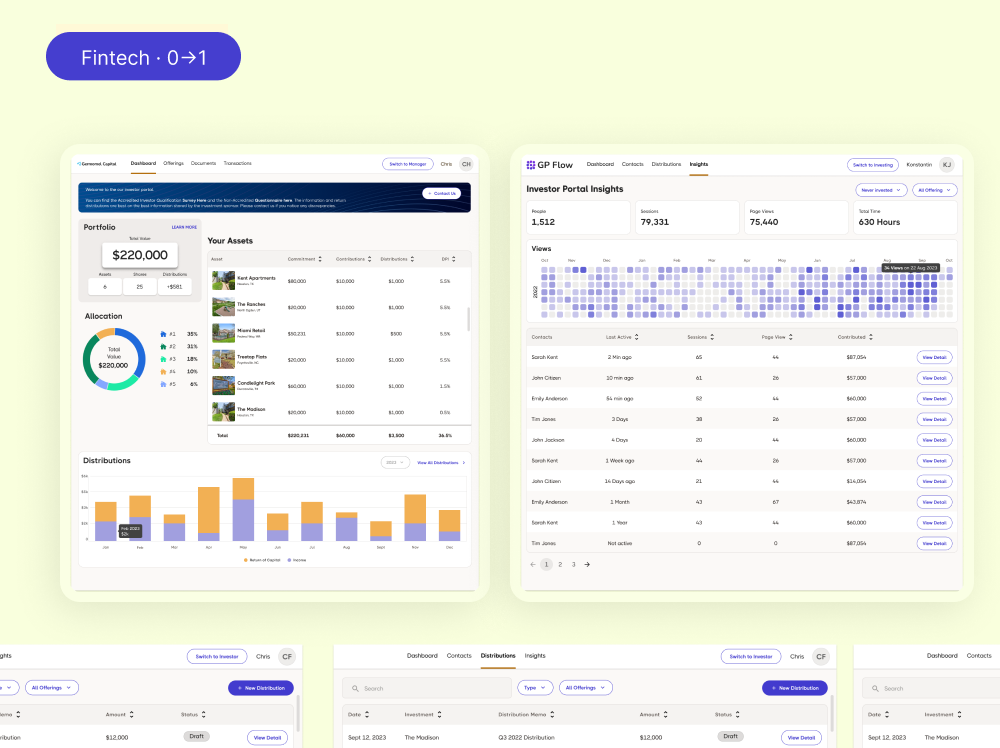
The tricky part was the roles.
Sponsors need to manage offerings, contacts and distributions. Investors need to understand commitments, documents and the status of their money. Giving both roles the same interface would compete with the task each person came to complete.
The design question: how can the platform serve both roles while making it clear which actions and information belong to each?
Start with what each role needs to do.
The architecture separates sponsor and investor journeys, while keeping shared areas such as documents and transactions recognisable. The screens use an explicit role switch and consistent navigation patterns.
What I Was Working With?
This was one of my first freelance product contracts. To ground the design, I surveyed 24 sponsors and investors and audited the workflows of legacy platforms. Participants came from Reddit, Facebook, and my personal network, so I treated the results as directional signal, not proof.
3 Data-Driven Decisions That Rewrote the Architecture:
- 41% of investors lost track of table headers on 13-inch laptops because of nested scrolling. I flattened the layout into one scroll and pinned the identity columns so they stay visible.
- 29% of retail investors hit clipped rows and broken tables on mobile. I designed a responsive pattern where table rows collapse into summary cards.
- Every fund manager I surveyed reported lag with large datasets (n = 25). I recommended moving full transaction logs into downloadable spreadsheets.
A few decisions that mattered.
Put the portfolio into context.
The investor overview combines a high-level portfolio summary with an asset table and distribution history. The hierarchy moves from overall position to individual investments.
The trade-off: A summary makes the first read easier, but it cannot explain every financial detail. The asset-level view needs to remain easy to reach.
Keep role and task visible.
The interface gives sponsors and investors distinct workspaces and a visible way to switch between them. Navigation follows the work performed in the current role.
The trade-off: Role switching is useful for people wearing both hats. It also needs clear labels and permission handling so an action is never ambiguous.
Make status part of the workflow.
Status labels, structured forms and document-related screens communicate where a task stands and what information belongs together.
The trade-off: A status badge is only useful when its meaning is clear. Labels, error states and the next permitted action must agree.
What I designed.
- Separate sponsor and investor experiences within a shared product structure.
- Dashboard layouts that connect high-level summaries to detailed records.
- Interface patterns for investment, document and distribution workflows.
The core design challenge is keeping people oriented as their role, information and next action change.
What I’d test next
Task completion for locating a document, understanding an investment’s status and completing a distribution workflow. I would also test whether users can identify their current role without prompting. These are proposed evaluation measures, not reported results.
Request full Figma Walkthrough ↗